Loading...
Searching...
No Matches
ConsoleForge.Core.IComponent Interface Reference
A self-contained sub-program: owns its own state, update logic, and view. More...
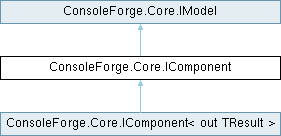
Inheritance diagram for ConsoleForge.Core.IComponent:
Additional Inherited Members | |
| Public Member Functions inherited from ConsoleForge.Core.IModel | |
| ICmd? | Init () |
| Called once at program start. | |
| IWidget | View () |
| Produce the root widget for the current model state. | |
| Public Attributes inherited from ConsoleForge.Core.IModel | |
| IModel | Model |
| Pure update function. | |
Detailed Description
A self-contained sub-program: owns its own state, update logic, and view.
Implements IModel so it can be run standalone via Program.Run or embedded inside a parent model.
Use IComponent<TResult> when the component needs to signal completion and return a typed result to its parent.
Pattern — define one sealed record per logical screen or reusable interactive widget, implement IComponent, and embed it as a typed field in the parent model:
{
public int Counter { get; init; }
{
if (Keys.Handle(msg) is { } action) msg = action;
return msg switch
{
NavUpMsg => (this with { Counter = Counter + 1 }, null),
_ => (this, null),
};
}
}
// In the parent model:
record AppModel(MyPage Page, ...) : IModel
{
{
var (next, cmd) = Component.Delegate(Page, msg);
return (this with { Page = next }, cmd);
}
}
KeyMap On(ConsoleKey key, Func< IMsg > handler)
Bind a key (any modifiers) to a message factory.
Definition KeyMap.cs:35
A self-contained sub-program: owns its own state, update logic, and view.
Definition IComponent.cs:53
The root interface for all ConsoleForge application models.
Definition IModel.cs:10
Marker interface for all messages flowing through the event loop.
Definition IMsg.cs:7
record QuitMsg
Signals the program loop to exit cleanly.
Definition Messages.cs:6
delegate Task< IMsg > ICmd()
A command: an async function that produces one message when complete.
record TextBlock
A widget that renders a single string, wrapping at region width.
Definition TextBlock.cs:10
The documentation for this interface was generated from the following file:
- src/ConsoleForge/Core/IComponent.cs